Purple Carrot Color Natural Anthocyanin Pigment for Food & Cosmetics
Purple Carrot Color Natural Anthocyanin Pigment for Food & Cosmetics
Natural Purple Carrot Pigment for Food & Beauty
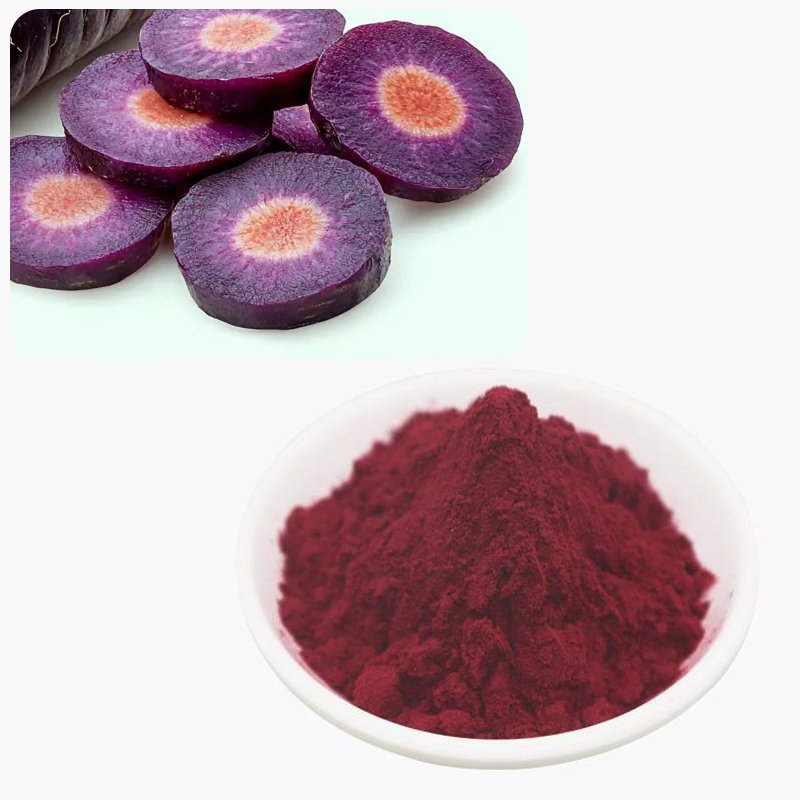
Purple Carrot Color is a natural anthocyanin pigment extracted from the roots of Daucus carota L. var. sativa (purple carrot). Rich in natural anthocyanins, it delivers a brilliant purple-red hue with excellent stability and solubility. Available in both liquid and powder forms, this pigment is easily soluble in water and ethanol, making it highly adaptable for a wide range of product applications.
Our Purple Carrot Color is produced using advanced purification techniques to ensure high purity, vivid color intensity, and safety. It is a clean-label, plant-based coloring solution that meets the increasing demand for natural alternatives to synthetic dyes in the food, beverage, cosmetic, nutraceutical, and pharmaceutical industries.
Certified under ISO9001, FSSC22000, FDA, Organic, Kosher, and Halal standards, our product adheres to the highest international quality and food safety requirements. With over 60,000 acres of pollution-free carrot cultivation bases, we guarantee full traceability, consistency, and sustainability from farm to pigment.
Purple Carrot Color is especially valued for its vivid color, strong coloring power, and excellent stability under acidic conditions (pH 3.0–5.0). It retains a stable purple-red tone with good light and heat resistance, making it ideal for confectionery, beverages, fruit juices, bakery, processed meats, and even cosmetics.
Description
Key Features & Benefits
1.100% Natural Anthocyanin Pigment – Extracted from edible purple carrots.
2. Bright Purple-Red Hue – Strong color strength and visual appeal.
3. Highly Water-Soluble – Perfect for liquid and semi-solid formulations.
4. Excellent Light & Heat Resistance – Greater stability than many other anthocyanin pigments.
5.Stable in pH 3.0–5.0 Range – Ideal for acidic beverages and fruit-based foods.
6.Functional Bioactive Properties – Naturally rich in antioxidants, supporting clean-label trends.
7. Sustainable & Safe – Produced under ISO and FSSC-certified systems with organic traceability.
Purple Carrot Color (Anthocyanin Pigment) is a naturally derived coloring agent obtained from the roots of purple carrots, known for their deep violet and reddish-purple hues. These colors are primarily attributed to anthocyanins, natural polyphenolic compounds with both coloring and antioxidant properties.
Using pure water extraction and membrane purification, the pigment is refined to achieve excellent clarity, stability, and consistency, free from harmful solvents or additives. The final product appears as a purple-red liquid or fine powder, offering strong coloring power and superior compatibility in aqueous systems.
Composition and Solubility
The main active compounds in Purple Carrot Color are anthocyanins, mainly cyanidin and peonidin derivatives. These compounds are highly soluble in water and slightly soluble in ethanol solutions.
At pH 3.0–5.0, the pigment maintains a stable and vivid purple-red tone. Its color expression changes subtly with pH levels:
pH < 3: bright red tones
pH 3–5: stable purple-red (ideal range)
pH > 6: fades toward blue or grey
This color behavior makes Purple Carrot Color a perfect choice for acidic foods and beverages like fruit juices, soft drinks, and jams.
Stability and Performance
Compared to many natural pigments, Purple Carrot Color shows better light and thermal stability, especially when formulated within its optimal pH range. Its high stability makes it a preferred natural coloring agent for products requiring pasteurization or baking.
Key stability features:
1.Resistant to moderate heat treatment
2.Retains hue under controlled light exposure
3.Maintains color stability in acidic environments
4.Compatible with water-based formulations and hydrocolloids
Certifications & Quality Assurance
Our Purple Carrot Color is produced under the most rigorous global food safety standards:
ISO 9001 Quality Management Certification
FSSC 22000 Food Safety Certification
FDA Registered Production
Organic Certification
Kosher and Halal Certified
Each batch undergoes comprehensive analytical testing for purity, color strength, pH stability, microbial safety, and heavy metals, ensuring compliance with international regulatory requirements.
With over 60,000 acres of pesticide-free carrot cultivation, we control the entire supply chain—from raw material to final pigment—ensuring both high-quality consistency and environmental sustainability.
Applications
1.Food & Beverage Industry
Purple Carrot Color is widely used for its natural brilliance and safety in:
1.1Soft drinks, fruit juices, and functional beverages
1.2Confectionery, gummies, and jellies
1.3Bakery products, cakes, and frostings
1.4Yogurt, dairy desserts, and smoothies
1.5Meat and sausage products
1.6Sauces, jams, and pickled vegetables
Its pH stability (3–5) makes it especially suitable for acidic food products, where many other natural pigments fail to retain color.
2.Cosmetics & Personal Care
Due to its natural anthocyanin origin and antioxidant benefits, Purple Carrot Color is ideal for clean-label cosmetic formulations, such as:
2.1Lip balms, lipsticks, and blushes
2.2Creams and serums with natural coloring
2.3Bath and spa products
2.4Hair and skincare formulations
It is vegan, biodegradable, and gentle on skin—perfect for eco-friendly and organic beauty brands.
Nutraceuticals & Pharmaceuticals
Rich in anthocyanins, this pigment also provides antioxidative and anti-inflammatory properties, making it suitable for functional foods, health supplements, and capsules. Its dual role as both colorant and bioactive compound supports the development of natural wellness-oriented products.
Appearance:Purple-red powder or liquid
Source:Purple carrot root (Daucus carota L.)
Main:Component Anthocyanins (cyanidin derivatives)
Solubility:Water-soluble, slightly soluble in ethanol
pH Stability:Optimal at pH 3.0–5.0
Heat Resistance:Good
Light Resistance:Good
Shelf Life:24 months (cool, dry storage)
Certification:ISO, FSSC, FDA, Organic, Kosher, Halal
Packaging & Storage
Packaging: 1kg aluminum foil bags / 25kg drums
Storage: Keep sealed, away from light and moisture, under 25°C.
Shelf Life: 24 months under recommended conditions.
Proper handling ensures retention of pigment intensity and antioxidant properties throughout its shelf life.
Why Choose Us
Over 20 years of experience in natural pigment extraction
Global supply capability to over 50 countries
Tailored formulation support for beverage, food, and beauty industries
Purple Carrot Color combines vivid natural beauty, safety, and performance, representing the next generation of clean-label, plant-based pigments. Its rich anthocyanin profile offers both brilliant coloration and functional health benefits, making it a premium choice for brands seeking to elevate their formulations naturally and sustainably.
Standard plant extract series
| Item No | Product name | Active ingredients | Specification | Item No | Product name | Active ingredients | Specification | |
| 1 | Ginkgo Biloba Extract | Flavonoids,Lactones | 24%,6% | 54 | Mangosteen Extract | AlphaMangostina | 10-90% | |
| 2 | Shitake Mushroom Extract | Polysaccharides (UV) | 30%, 40%,50% | 55 | RoseHipExtract | Flavones | 1-20% | |
| 3 | Ivy Leaf Extract | Total Hederasaponins | 5%-60% | 56 | Schisandra Berry Extract | Schizandrins | 2-9% | |
| 4 | Ginseng Extract | Ginsenosides | 5%-80% | 57 | Cassia Seed Extract | Anthaquinone | 3% | |
| 5 | Ginger Extract | Gingerols | 5%,10%,25% | 58 | Soybean Extract | soy lsoflavones | 40% | |
| 6 | Rhodiola Rosea Extract | Salidroside, Rosavins | 3%-98%,3% | 59 | Chaga Extract Powder | Polysaccharides | 50% | |
| 7 | Ganoderma Extract | Polysaccharides (UV) | 30%,40%,50% | 60 | Hericium Erinaceus Extract | Polysaccharides | 30% | |
| 8 | Red Clover Extract | Total Isoflavones | 8%,10%,20%,40% | 61 | Trametes Versicolor Extract | Polysaccharides | 30% | |
| 9 | Grape Seed Extract | OPC | 95% | 62 | Cordyceps Militaris Extract | Polysaccharides | 30% | |
| 10 | Turmeric Extract | Curcumin | 95% | 63 | Ginkgo Biloba Extract | Ginkgo Flavonoids | 24% | |
| 11 | Quercetin | Quercetin | 95% | 64 | Angelica Sinensis Extract | Ferulic Acid | 1% | |
| 12 | Rutin | Rutin | 95% | 65 | Eleuthero Extract | Eleutherosides | 0.8% | |
| 13 | Diosmin | Diosmin | 90% | 66 | Gymostemma Extract | Gypenosides | 80% | |
| 14 | Hespridin | Hespridin | 90% | 67 | Hawthorn Extract | Proanihocyanidins | 20% | |
| 15 | Marigold Extract | Lutein / Zeaxanthin | 2%-80% | 68 | Ephedra Extract | Ephedrine | 8% | |
| 16 | Griffonia Simplicifolia Extract | 5-HTP | 10%-99% | 69 | Olive Leaf Extract | Oleuropein | 20% | |
| 17 | Kava Extract | Kavalactones | 30%,50%,70% | 70 | Centella Asiatica Extract | Asiaticoside | 40% | |
| 18 | Hawthorn Extract | Flavonoids | 2%,50% | 71 | Calendula Extract | Lutein | 5% | |
| 19 | Hibiscus Flower Extract | Anthocyanins | 5%-25% | 72 | Chamomile Extract | Aigenin | 1% | |
| 20 | Lion’s Mane Mushroom Extract | Polysaccharides (UV) | 30%,40%,50% | 73 | Senna Leaf Extract | Sennosides | 20% | |
| 21 | Maitake Mushroom Extract | Total Sugars (UV) | 30%,40%,50% | 74 | Chicory Extract | lnulin | 20% | |
| 22 | Mangosteen Extract | α-Mangostin | 10%-98% | 75 | Panax Notoginseng Extract | Notognsenosides | 5% | |
| 23 | Apple Cider Vinegar Powder | Apple Cider Vinegar Powder | 5%-50% | 76 | Polygonum Cuspidatum Extract | Resvetrol | 10-98% | |
| 24 | Yucca Extract | Saponins | 10%~98% | 77 | Kudzu root extract | puerarin | 15-98% | |
| 25 | Broccoli Extract | Glucoraphanin | 1%-20% | 78 | Scutellaria Extract | Baicalin | 85% | |
| 26 | Semen Ziziphi Spinosae Extract | Saponins | 1%-10% | 79 | Mulberry Leaf Extract | Sodium copper chlorophylin | 99% | |
| 27 | Echinacea Purpurea Extract | Chicoric Acid | 1%-4% | 80 | Alpha Lipoic Acid | Alpha Lipoic Acid | 99% | |
| 28 | Eucommia Leaf Extract | Chlorogenic Acid | 5%-98% | 81 | Coenzyme Q10 | Coenzyme Q10 | 98% | |
| 29 | Senna Leaf Extract | Sennosides A+B | 6%,8%,10%,20%,30% | 82 | pymoloquinoine Qunone Diodum(sait pqq) | pymoloquinoine Qunone Diodum(sait pqq) | 99% | |
| 30 | Scutellaria Root Extract | Baicalin | 88% | 83 | B-Nicinamide mononucleotie(NMN) | B-Nicinamide mononucleotie(NMN) | 99% | |
| 31 | Bitter Apricot Extract | Amygdalin | 98% | 84 | Astragalus Extract | Astragalus polysaccharides | 5-98% | |
| 32 | Soapnut Extract | Sapindus Saponins | 30%-80% | 85 | Scutellaria Extract | Scutellaria polysaccharide | 30%,50%,70% | |
| 33 | Pine Bark Extract | OPC | 95% | 86 | Green Tea Extract | Green Tea polyphenols | 50-98% | |
| 34 | Berbcrine Hydrochloride | Berberine Hydrochloride | 97% | 87 | GRAPE SKIN EXTRACT | Resveratrol | 5-20% | |
| 35 | Black Garlic Extract | Allicin | 1%-5% | 88 | Grape Seed Extiact | Proanthocyanidins | 95% | |
| 36 | Centella Asiatica Extract | Asiaticoside | 10%-70% | 89 | Turmeric Extract | Curcumin | 95% | |
| 37 | Aloe Yera GelFreeze Dried Powder | Freeze-Dried Aloe Vera Gel Powder | 50:1,100:1,200:1 | 90 | PanaxGinsengExtract | Ginsenosides | 10-80% | |
| 38 | Magnolia Bark Extract | Honokiol | 50%-98% | 91 | Pomegranate Extiact | Ellagic ACid | 40-90% | |
| 39 | Cyanotis Arachnoidea Extract | Ecdysterone | 2%-90% | 92 | Elderberry Extract | Anthocyanidin | 1-25% | |
| 40 | Epimedium Extract | Icariin | 1%-98% | 93 | Passiflora incarnate Extract | Flavone | 5% | |
| 41 | Cactus Extract | Polysaccharides | 10%-30% | 94 | Shiitake Mushroom Extract | Shiitake mushrooms | 10-50% | |
| 42 | Chaga Mushroom Extract | Polysaccharides (UV) | 30%, 40%,50% | 95 | Ganoderma lucidum Extract | Ganoderma lucidum | 10-50% | |
| 43 | Cistanche Desertcola Extract | Total Glycosides | 20%-80% | 96 | white willow Bark extract | Salicin | 15-98% | |
| 44 | Green Tea Extract | EGCG | 30%-98% | 97 | Rhodiola Rosea Extract | Salidroside | 1-3% | |
| 45 | Apple Exttact | Polyphenols | 1-70% | 98 | Marigold Flower Extract | Lutein | 5-20% | |
| 46 | Bilbery Leat Extract | Flavones | 1-20% | 99 | Milk Thistle Extract | Sillymarin | 80% | |
| 47 | Cinnamon Bark Extract | Flavones | 1-30% | 100 | wild Yam Extract | Diosgenin | 20-98% | |
| 48 | Pine Bark Extract Powder | Proanthocyuanidins | 95% | 101 | Echinacea purpurea Extract | Chicory Acid | 1-3% | |
| 49 | Epimedium Extract | ICcarins | 1-98% | 102 | Sophora Japonica Extract | Rutin | 95% | |
| 50 | Grapeseed Extract | CProarthocyanidins | 95% | 103 | Sophora Japonica Extract | Quercetin | 95% | |
| 51 | Goji Extract | Povsaccharides | 5-60% | 104 | Aloe vera Extract | Aloin | 20% | |
| 52 | Rosemary Extract | RosemaryAcid | 5% | 105 | Haematococcus pluvialis Extract | Astaxanthin(Powder/oil) | 5% | |
| 53 | Horsetail Extract | silica | 7% | 106 | Tomato Extract | LYCOPENE(Powder/oil) | 5%,10% |
Frequently Asked Questions (FAQ) – Purple Carrot Color
1. What is Purple Carrot Color?
Purple Carrot Color is a natural anthocyanin-based pigment extracted from purple carrots (Daucus carota L. var. sativa). It provides a bright purple-red hue and is widely used as a clean-label coloring solution in food, beverages, cosmetics, nutraceuticals, and pharmaceuticals.
2. What are the main active components?
The primary active components are anthocyanins, especially cyanidin derivatives, which give the pigment its strong purple-red coloration and antioxidant properties.
3. What forms are available?
Purple Carrot Color is available in:
-
Liquid form
-
Powder form (spray-dried or concentrated)
Both forms are water-soluble and suitable for various industrial applications.
4. Is the pigment stable during processing?
Yes. Purple Carrot Color is stable under acidic conditions (pH 3.0–5.0) and demonstrates strong resistance to heat and light in low-pH formulations. It performs best in beverages, confectionery, fruit products, and acidic food systems.
5. What is the recommended pH range for optimal color stability?
The recommended pH range is 3.0–5.0, where the pigment maintains its vivid purple-red tone and the best stability.
6. Is Purple Carrot Color suitable for clean-label products?
Absolutely. It is plant-based, non-GMO, allergen-free, and ideal for brands seeking natural alternatives to synthetic dyes such as Red No. 40 or Red No. 3.
7. Which industries commonly use Purple Carrot Color?
It is widely used in:
-
Beverages & juices
-
Candies & gummies
-
Jams, fillings, and fruit preparations
-
Bakery decorations & icings
-
Dairy products
-
Processed meats
-
Nutraceutical supplements
-
Cosmetics and personal care
8. What certification does your Purple Carrot Color have?
Our product is certified under:
-
ISO9001
-
FSSC22000
-
FDA
-
Organic
-
Kosher
-
Halal
All batches meet international safety and quality standards.
9. Do you support full traceability?
Yes. We manage over 60,000 acres of pollution-free carrot cultivation bases, enabling complete traceability from raw material harvesting to final pigment production.
10. Is Purple Carrot Color water-soluble?
Yes. It is highly soluble in water, and also disperses well in ethanol for specialized formulations.
11. Can it be used in neutral pH or alkaline products?
Purple Carrot Color is not recommended for neutral or alkaline pH (above 6.0), as anthocyanins may shift color or lose stability. If needed, we can suggest alternative pigments for such applications.
12. What is the shelf life?
Typically:
-
Powder: 24 months
-
Liquid: 12–18 months
Shelf life may vary depending on storage conditions (keep cool, dry, away from light).
13. Do you provide samples?
Yes, we offer free samples for testing and formulation development. Customized specifications can also be arranged.
14. What packaging options are available?
Standard packaging includes:
-
Powder: 1–25 kg/drum
-
Liquid: 1–20 kg/drum
Custom packaging is available upon request.
15. Can the pigment be customized?
Yes. We can customize color strength, concentration, carrier type, and formulation to meet specific application needs.



Reviews
There are no reviews yet.