
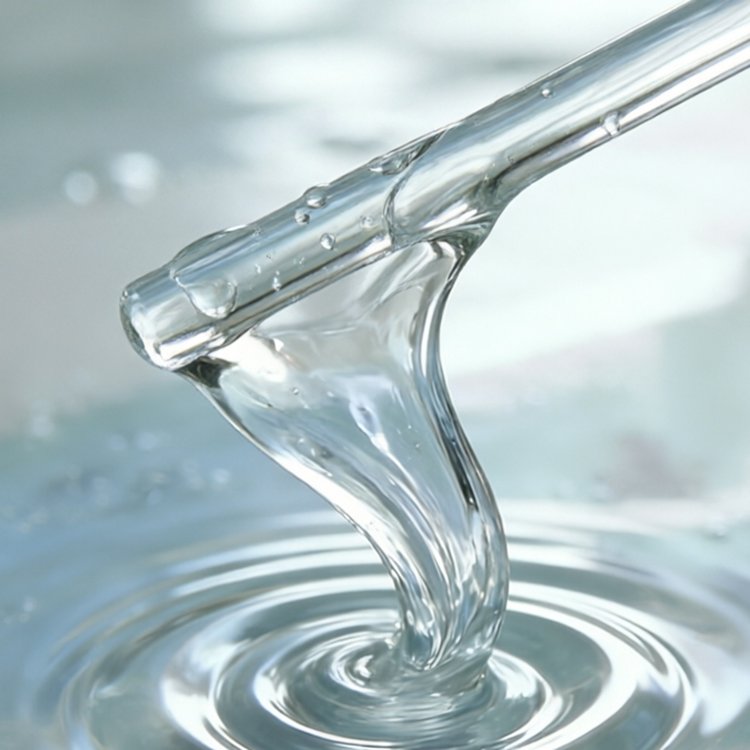
Sodium Hyaluronate Crosslinked Polymer Hydrating Gel for Cosmetics
Sodium Hyaluronate Crosslinked Polymer Hydrating Gel for Cosmetics
Crosslinked HA for Skincare & Haircare Products
Sodium Hyaluronate Crosslinked Polymer is a high-performance hyaluronic acid derivative obtained through advanced crosslinking technology, resulting in a dense three-dimensional network structure. The crosslinking process allows the polymer to fold and locally aggregate, increasing its water-binding capacity and forming a protective, hydrating film on the skin surface. This unique structure enhances not only hydration and moisturizing effects but also acts as a free radical scavenger, alleviating sun-induced discomfort and reducing the formation of blisters. Crosslinked HA can also serve as a delivery system for water-soluble or oil-soluble active ingredients, improving the stability and efficacy of formulations.
Description
Product Name: Sodium Hyaluronate Crosslinked Polymer
Molecular Weight Range: Crosslinked network polymer (MW > 3,000 kDa, measured)
Appearance: White to pale yellow powder or granular form; forms gel upon hydration
Functions: Hydration, Film-Forming, Moisturizing, Anti-Oxidation, Skin Protection, Delivery System for Active Ingredients
Molecular Formula: (C₁₄H₂₁NO₁₁)n
CAS Number: 9067-32-7
Applications in Cosmetics and Personal Care:
Crosslinked Sodium Hyaluronate is widely used across multiple product categories, including skincare, haircare, cleansing products, oral care, nail and lip care, sunscreens, handmade soaps, and other personal care formulations. Recommended usage levels range from 0.3% to 10%, depending on the formulation and desired effect. Its ability to form gels upon hydration makes it ideal for long-lasting moisturizing creams, serums, hair masks, and other products requiring sustained hydration and protective barrier formation.
Certificate of Analysis (COA)
| Parameter | Requirement | Test Result |
| Appearance | White to pale yellow powder or granules | Compliant |
| Infrared Absorption | Must match reference spectrum | Compliant |
| Sodium Salt Identification | Positive reaction | Compliant |
| Glucuronic Acid (%) | ≥45.0 | 47.07 |
| Sodium Hyaluronate Content (%) | ≥92.0 | 97.32 |
| Average Relative Molecular Mass | Measured value 80–120% of labeled | 3021 |
| Absorbance (5mg/ml, H2O, 280nm) | ≥99.0 | 0.045 |
| Solution Transmittance (%) | ≤0.25 | 100 |
| Loss on Drying (%) | ≤10.0 | 7.72 |
| pH (5mg/ml) | 5.0–8.5 | 6.08 |
| Heavy Metals (as Al, mg/kg) | ≤20 | <20 |
| Protein (%) | ≤0.10 | 0.012 |
| Total Bacterial Count (CFU/g) | ≤100 | <10 |
| Yeast & Mold (CFU/g) | ≤50 | <10 |
| Staphylococcus aureus | Not detected | ND |
| Pseudomonas aeruginosa | Not detected | ND |
Product Features:
1.Enhanced Hydration and Film Formation: The crosslinked network retains large volumes of water, forming a breathable film on the skin surface for long-lasting moisture and protection.
2.Anti-Oxidation and Skin Protection: Acts as a free radical scavenger, mitigating photodamage and environmental stress effects.
3.Versatile Delivery System: Supports controlled release of both water-soluble and oil-soluble active compounds, enhancing product efficacy.
4.High Purity and Safety: Manufactured in ISO9001, HACCP, GMP-certified facilities with ISO14001 environmental management system. Sodium hyaluronate content is stable at 97–99%, glucuronic acid ≥46%, protein ≤0.05%, and endotoxin <0.07 EU/mg. Heavy metals and microbial contamination are strictly controlled.
5.Excellent Compatibility: Fully compatible with glycerin, surfactants, peptides, and various bioactive ingredients, making it suitable for diverse cosmetic and personal care formulations.
6.High Stability: Viscosity and hydrolytic stability remain consistent across batches, even after standing under normal conditions for several days.
How to Evaluate Quality:
1.Appearance: pure white or pale yellow, fine powder with no black spots.
2.Microbial control: low colony counts, sterile production process.
3.Particle size: uniform, avoiding oversized aggregates.
4.Solution clarity: high transparency upon hydration indicates excellent light transmittance.
5.Glucuronic acid content and protein levels indicate effective HA content and safety.
Storage and Handling:
1.Store in a sealed container in a cool, dry place at 2–8°C to prevent moisture absorption.
2.Use purified or distilled water for dissolution to maintain clarity.
3.Once dissolved, use immediately or add preservatives for extended storage.
4.Avoid mixing with cationic surfactants or preservatives to prevent turbidity or precipitation.
Why Choose Our Product:
1.Rigorous filtration and sterile production ensure high purity and safety.
2.Accurate molecular weight measurement for precise formulation design.
3.Clear, stable gel formation without yellowing, outperforming other commercial products.
4.Excellent batch-to-batch consistency and controlled physicochemical properties.
5.Ideal for OEM/ODM cosmetic, personal care, haircare, and pharmaceutical products.
Frequently Asked Questions (FAQ) – Sodium Hyaluronate Crosslinked Polymer
1. What is Sodium Hyaluronate Crosslinked Polymer?
Sodium Hyaluronate Crosslinked Polymer is a modified form of hyaluronic acid created through advanced crosslinking technology. It forms a dense three-dimensional network structure that enhances moisture retention, provides a smooth skin feel, and offers long-lasting hydration.
2. How does the crosslinking technology improve performance?
Crosslinking connects hyaluronic acid molecules into a stable network, allowing the polymer to hold large amounts of water and gradually release moisture. This structure creates a hydrating and protective film on the skin, maintaining long-term moisturization.
3. What are the main functions of Crosslinked Sodium Hyaluronate?
It deeply hydrates the skin, reduces transepidermal water loss (TEWL), improves elasticity, and provides a soft, smooth texture. Additionally, it helps neutralize free radicals, relieve sun-induced discomfort, and support skin barrier repair.
4. In which applications can it be used?
This ingredient is ideal for use in skincare formulations such as creams, lotions, serums, masks, and after-sun products. It can also be applied in haircare and cosmetic formulations requiring long-lasting hydration and skin protection.
5. Can Crosslinked HA be used as a delivery system?
Yes. Its three-dimensional network can encapsulate and carry both water-soluble and oil-soluble active ingredients, enhancing their stability, bioavailability, and sustained release in cosmetic or pharmaceutical formulations.
6. How is it different from regular Sodium Hyaluronate?
Unlike standard HA, which provides quick but short-term hydration, the crosslinked version offers extended moisturizing effects due to its stable 3D gel structure. It also forms a smoother film and provides better resistance to environmental stress.
7. What are the recommended formulation levels?
Typical use concentrations range from 0.1% to 1.0%, depending on the desired texture, hydration level, and product type. It can be easily incorporated into water-based formulations.
8. Is the product safe and biocompatible?
Yes. Sodium Hyaluronate Crosslinked Polymer is non-irritating, biocompatible, and suitable for all skin types, including sensitive skin. It meets cosmetic-grade purity standards and is free from harmful additives.
9. How should it be stored?
Store in a cool, dry place away from direct sunlight. Keep the container tightly sealed to maintain product stability and prevent moisture absorption.
10. Does it have synergistic effects with other ingredients?
Yes. It works well with other moisturizing agents, peptides, antioxidants, and botanical extracts, further enhancing skin hydration, firmness, and protection.

Reviews
There are no reviews yet.