
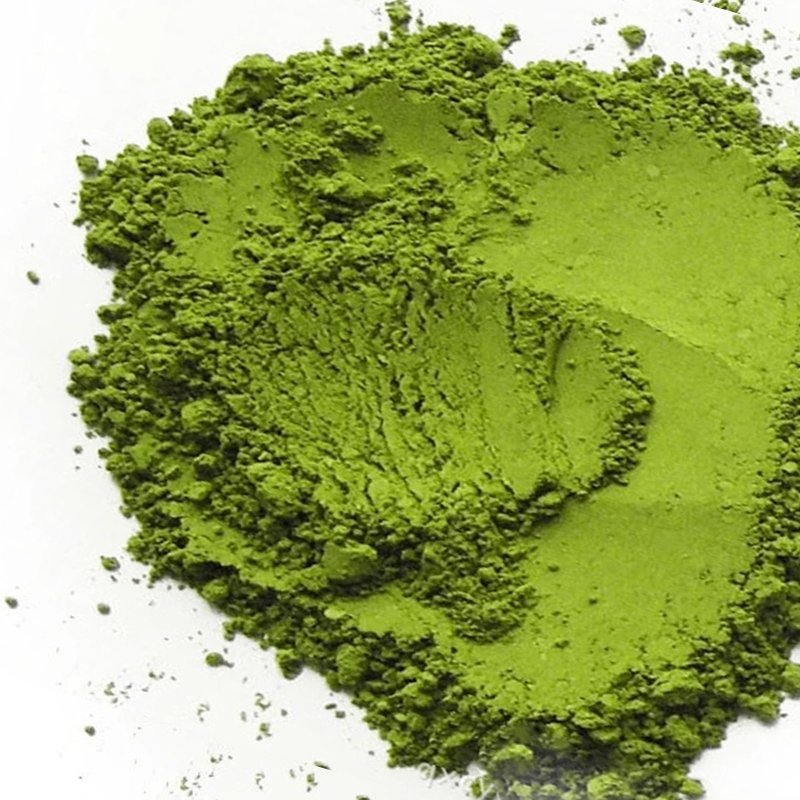
Premium Grade Matcha Powder for Beverages & Food Applications
Premium Grade Matcha Powder is produced from carefully selected tea leaves cultivated in high-altitude mountain areas at elevations of 500–800 meters, where a vertical climate with day–night temperature differences exceeding 10°C significantly extends the tea plant growth cycle. This unique environment promotes the accumulation of amino acids and tea polyphenols, resulting in richer nutrition and superior flavor.
The tea variety used for this grade is Jingshan tea from Hangzhou, a traditional Chinese cultivar known for its clean aroma and balanced taste. Laboratory testing shows an amino acid content of up to 1.0%, contributing to a pronounced umami profile and smooth mouthfeel.
Shaded cultivation is applied before harvest to enhance chlorophyll and L-theanine levels. The leaves are processed using non-rolling techniques and low-temperature steam fixation, followed by ultra-fine grinding above 800 mesh, producing a fluffy, bright green powder with excellent suspension and easy dispersion.
With its vivid green color, distinct shaded aroma, seaweed notes, and rich yet mellow taste, this Premium Grade Matcha is ideal for daily drinking, tea beverages, ice desserts, and matcha lattes. OEM customization for particle size, specifications, and packaging is available for global B2B clients.
Premium Grade Matcha Powder for Beverages & Food Applications
Premium Grade Matcha Powder Bright Green & Umami
Description
1. Tea Origin & Cultivar
Our Premium Grade Matcha is sourced from a core tea-growing zone located in mountainous regions at 500–800 meters above sea level. The significant temperature difference between day and night slows tea plant growth, allowing higher accumulation of amino acids, tea polyphenols, and chlorophyll.
The tea variety used is Hangzhou Jingshan tea, a well-established cultivar valued for its clean aroma and full-bodied taste. With an amino acid content reaching 1.0%, it delivers a noticeable umami sensation and smooth, refreshing aftertaste, making it especially suitable for beverage and food applications.
Green planting practices are strictly implemented, including organic fertilizer substitution, biological pest control, and intelligent tea garden management systems. Soil moisture, temperature, and humidity are monitored in real time to ensure stable quality and sustainable production.
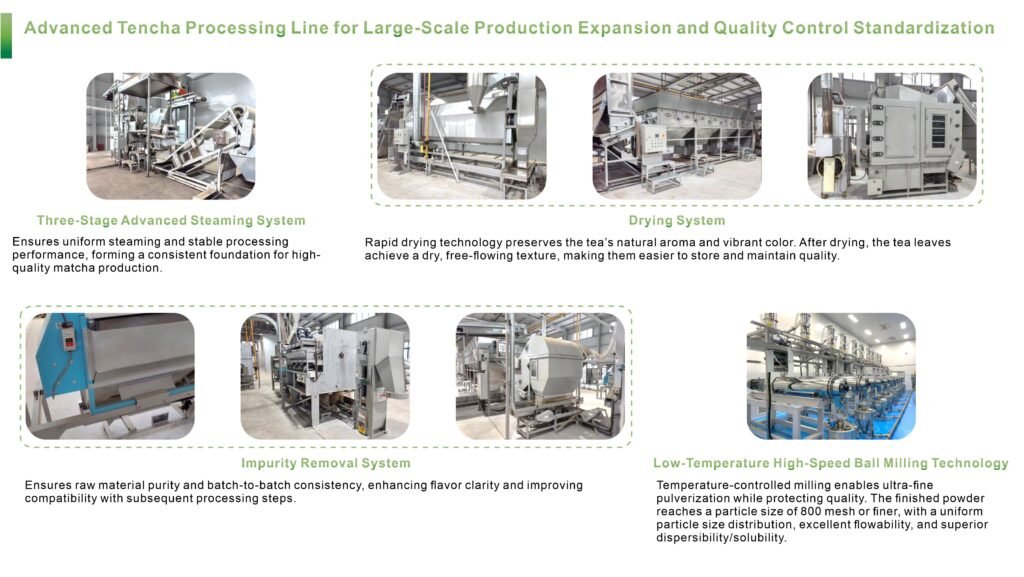
2. Processing Technology
Unlike conventional green tea powder, our matcha is produced using specialized non-rolling processing techniques, designed specifically for matcha quality requirements.
Primary Processing Steps:
1.Shading before harvest to enhance leaf tenderness and chlorophyll
2.Controlled withering to promote internal flavor development
3.Steam fixation using advanced multi-stage steamers to preserve nutrients
4.Rapid air cooling to prevent overheating
5.Initial drying for moisture reduction
6.Stem and impurity removal for raw material purity
7.Aroma-enhancing secondary drying
8.Optical color sorting
9.Preliminary grinding into Tencha
Refining Process:
1.Sterilization for food safety
2.Batch blending to ensure flavor consistency
3.Low-temperature ultra-fine grinding using continuous ball milling
4.Final particle size above 800 mesh, uniform and fluffy
5.Sieving, metal detection, X-ray inspection
6.Automatic weighing, packaging, labeling, and storage
3. Product Characteristics
●Color: Bright, vivid green
●Aroma: Shaded aroma with clear seaweed notes
●Taste: Rich, mellow, fresh umami with smooth mouthfeel
●Particle Size: ≥800 mesh, fine and well-dispersed
●Solubility: Excellent suspension, slow sedimentation
4. Nutritional Value
Our matcha contains over 30 essential nutrients and trace elements, including:
●L-Theanine
●Tea polyphenols
●Free amino acids
●Alkaloids
●Flavonoids
●Chlorophyll
●Vitamins
●Dietary fiber
●SOD (Superoxide Dismutase)
Consuming one cup of matcha is equivalent to drinking approximately 30 cups of regular green tea, as the whole tea leaf is ingested.
5. Functional Benefits
●Antioxidant Support: Tea polyphenols, flavonoids, and SOD help neutralize free radicals
●Lipid Regulation: Supports healthy cholesterol and triglyceride levels
●Digestive Support: Naturally alkaline; aids digestion and fat metabolism
●Mental Focus: Caffeine and aromatic compounds promote alertness without jitters
●Immune Support: L-Theanine and polyphenols help enhance immune response
6. Matcha vs. Conventional Green Tea Powder
| Aspect | Our Matcha | Regular Green Tea Powder |
| Cultivation | Shaded, selected cultivars | No shading |
| Processing | Steam-fixed, non-kneaded | Kneaded, mechanically crushed |
| Particle Size | ≥800 mesh | 40–200 mesh |
| Solubility | Excellent suspension | Clumping, rapid sediment |
| Color | Bright green | Yellowish, dull |
| Flavor | Umami, seaweed aroma | Bitter, coarse |
| Nutrient Absorption | Full-leaf intake | Poor absorption |
👉• 【EU Organic & Premium Matcha Powder 】
👉• 【First Grade Matcha Powder】
👉• 【Second Grade Matcha Powder 】
👉• 【Baking Grade Matcha Powder 】
7. Applications & Target Industries
Ideal for global B2B clients in:
●Tea beverages & RTD drinks
●Matcha lattes & milk tea
●Ice cream & frozen desserts
●Functional foods & nutritional products
●Health food and wellness brands
OEM / ODM services available, including customized specifications, formulations, and private labeling.
8. Quality Control & Certifications
Our production strictly follows international food safety and quality standards:
●FSSC 22000
●ISO 9001
●ISO 22000
●HACCP
Advanced testing equipment such as GC-MS, HPLC, and ultra-micro spectrophotometers ensure reliable detection of pesticide residues, heavy metals, and nutritional parameters.

First Grade Matcha Powder – FAQ
FAQ 1. How does First Grade Matcha differ from premium organic matcha?
First Grade Matcha offers a balanced profile between flavor, color, and cost.
Compared with premium organic matcha:
•Slightly lower amino acid content
•Strong matcha aroma
•Excellent color stability
It is designed for commercial beverage and foodservice use.
FAQ 2. What are the most common applications for First Grade Matcha?
This grade is widely used in:
•Matcha lattes
•Ice cream and frozen desserts
•Tea-based beverages
•Café and chain drink applications
Its flavor remains stable when combined with milk or sugar.
FAQ 3. Does this matcha suspend well in beverages?
Yes. With ultra-fine grinding (≥800 mesh), it offers:
•Good dispersion
•Minimal sedimentation
•Smooth mouthfeel
Ideal for both hot and cold beverages.
FAQ 4. Is First Grade Matcha suitable for large-scale production?
Yes. It is formulated for:
•Stable batch-to-batch quality
•Consistent color and flavor
•Cost-effective industrial use
This makes it suitable for chains and OEM projects.
FAQ 5. Can specifications be adjusted for different markets?
Yes. We support:
•Particle size tuning
•Flavor profile adjustment
•Blending for consistency
FAQ 6. Do you support private label or OEM customers?
Yes. We regularly support private label and OEM beverage brands with customized matcha solutions.


Reviews
There are no reviews yet.