
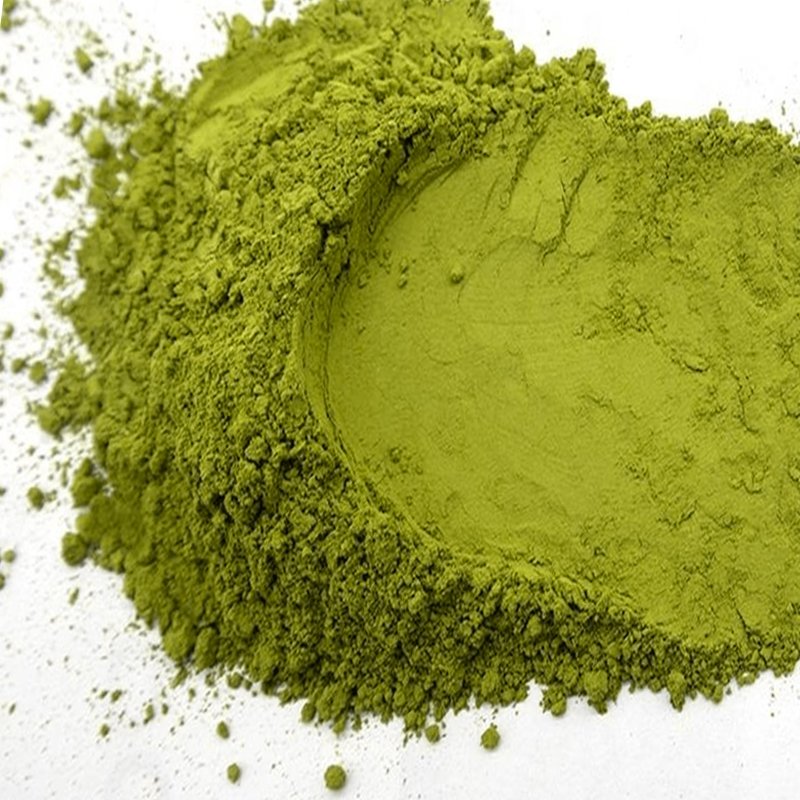
Baking Grade Matcha Powder for Bakery & Food Applications
Baking Grade Matcha Powder for Bakery & Food Applications
Baking Grade Matcha Powder High Value for Bakery
Baking Grade Matcha Powder is a cost-effective, flavor-forward matcha specifically developed for bakery, snack, and beverage applications. It is produced from a carefully blended selection of traditional Chinese tea cultivars, including Jiukeng, Small-leaf Fuding, and Chunbo Green, chosen for their strong tea character, baking stability, and layered flavor performance.
The tea leaves are sourced from a core mountainous cultivation zone at elevations of 500–800 meters, where a vertical climate with day–night temperature differences exceeding 10°C naturally extends the tea plant growth cycle. This environment promotes the accumulation of amino acids, tea polyphenols, and chlorophyll, forming a solid nutritional and sensory foundation for baking-grade matcha.
Through shaded cultivation, non-rolling processing, steam fixation, and low-temperature ultra-fine grinding, this matcha delivers a vivid green appearance, pronounced tea aroma, and a rich, well-balanced flavor that remains stable under high-temperature baking conditions. With excellent cost performance and broad formulation compatibility, it is an ideal choice for manufacturers producing matcha-flavored baked goods, snacks, cocoa products, and compound beverages. OEM specifications and customized formulations are available upon request.
Description
1. Tea Origin & Cultivar Blending
Our Baking Grade Matcha is produced using a multi-cultivar blending strategy, combining Jiukeng, Small-leaf Fuding, and Chunbo Green tea varieties. Each cultivar contributes unique characteristics—robust tea intensity, aroma depth, and processing stability—resulting in a matcha powder with strong tea presence and rich flavor layers.
The tea is grown in high-altitude mountain regions (500–800 m) with large diurnal temperature variation. This climatic advantage slows leaf growth, increases nutrient accumulation, and enhances the structural integrity of the leaf, making it particularly suitable for baking and industrial food processing.
Sustainable agricultural practices are implemented throughout cultivation, including organic fertilizer substitution, biological pest control, and intelligent tea garden management systems. Soil moisture, temperature, and humidity are continuously monitored to ensure consistent raw material quality.
2. Processing Technology
Unlike conventional green tea powder, our matcha production focuses on color retention, aroma stability, and application performance in baked and compounded foods.
Primary Processing:
1.Shading before harvest to improve leaf quality
2.Controlled withering to activate internal flavor transformation
3.Steam fixation to rapidly deactivate enzymes and lock in color
4.Forced air cooling to prevent thermal degradation
5.Initial drying for moisture reduction
6.Stem and impurity removal for raw material purity
7.Secondary drying to enhance aroma
8.Optical color sorting
9.Preliminary grinding into Tencha
Refining Process:
1.Sterilization to ensure food safety
2.Batch blending for flavor and color consistency
3.Low-temperature ultra-fine grinding
4.Sieving for uniform particle size
5.Metal detection
6.Packaging by specification
7.Weight verification
8.X-ray foreign object inspection
9.Labeling and warehousing
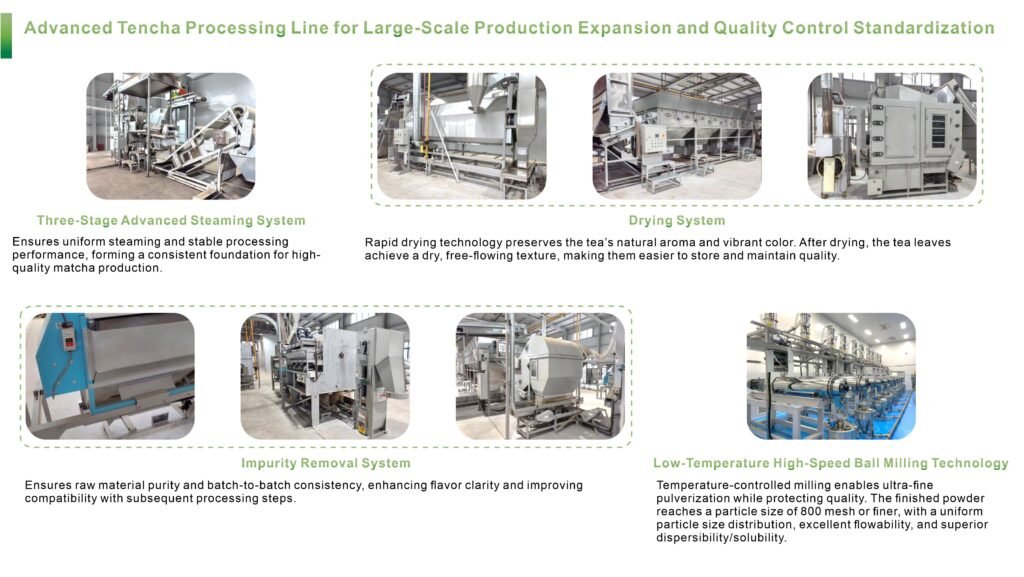
3. Equipment & Technical Advantages
●Three-stage steam fixation system: Maximizes retention of tea polyphenols, chlorophyll, and L-theanine
●Hot-break dryer: Efficient initial moisture reduction
●Mesh-type Tencha dryer: High drying efficiency with bottom hot-air circulation
●Aroma-enhancing dryer: Secondary roasting to activate tea aroma
●Continuous ball milling system: Low-temperature, high-speed milling achieving 800 mesh particle size with uniform distribution
●Impurity removal system: Enhances flavor purity and processing compatibility
4. Product Characteristics
●Color: Bright, natural green with good baking stability
●Aroma: Distinct tea fragrance with layered depth
●Taste: Strong tea flavor, balanced bitterness, smooth finish
●Particle Size:≥800 mesh, fine and fluffy
●Dispersibility: Easy blending into doughs, batters, and beverages
5. Nutritional Profile
Baking Grade Matcha retains the full nutritional spectrum of whole tea leaves and contains over 30 essential nutrients and trace elements, including:
L-Theanine, tea polyphenols, free amino acids, alkaloids, flavonoids, chlorophyll, dietary fiber, vitamins, SOD, and trace minerals.
Because matcha is consumed as a whole-leaf powder, one cup of matcha provides nutritional value equivalent to approximately 30 cups of traditionally brewed green tea.
6. Functional Benefits
●Antioxidant Support: Polyphenols, flavonoids, and SOD form a multi-layer antioxidant system
●Lipid Regulation: Supports healthy cholesterol and triglyceride levels
●Digestive Support: Naturally alkaline; promotes digestion and fat metabolism
●Mental Alertness: Caffeine and aromatic compounds enhance focus and energy
●Immune Support: L-theanine and tea polyphenols help regulate immune function
7. Matcha vs. Conventional Green Tea Powder
| Aspect | Matcha | Green Tea Powder |
| Cultivation | Shaded | Non-shaded |
| Processing | Non-rolling, steam-fixed | Rolled, mechanically ground |
| Particle Size | ≥800 mesh | 40–200 mesh |
| Color | Bright green | Dull yellow-green |
| Aroma | Fresh, seaweed & tea notes | Roasted, flat |
| Taste | Smooth, rich tea flavor | Bitter, coarse |
| Absorption | Whole-leaf intake | Poor absorption |
👉• 【EU Organic & Premium Matcha Powder 】
👉• 【First Grade Matcha Powder】
👉• 【Second Grade Matcha Powder 】
👉• 【Baking Grade Matcha Powder 】
8. Application Scenarios
Ideal for:
•Matcha cakes, cookies, bread, and pastries
•Matcha-flavored snacks and fillings
•Cocoa and chocolate products
•Beverage premixes and compound drinks
OEM / ODM services available:
•Particle size adjustment
•Color and flavor intensity customization
•Nutritional target customization
•Packaging and labeling solutions
9. Quality Control & Certifications
We operate under internationally recognized quality and food safety systems:
●FSSC 22000
●ISO 9001
●ISO 22000
●HACCP
Advanced analytical instruments such as GC-MS and HPLC ensure strict monitoring of pesticide residues, heavy metals, and nutritional indicators. Every batch undergoes full inspection, retention sampling, and traceability management.

Baking Grade Matcha Powder – FAQ
FAQ 1. What makes Baking Grade Matcha different from other grades?
Baking Grade Matcha is optimized for:
•Heat resistance
•Strong tea flavor
•Cost efficiency
It is designed specifically for baking and processed foods.
FAQ 2. What applications is Baking Grade Matcha best suited for?
Common applications include:
•Cakes and cookies
•Chocolates and fillings
•Snacks and biscuits
•RTM beverage bases
FAQ 3. Does the flavor remain after baking?
Yes. This grade is selected to:
•Retain tea flavor after heat processing
•Maintain aroma when combined with sugar, fats, and dairy
FAQ 4. Is color stability affected by baking?
Color may soften after high heat, which is normal.
However, it remains visually appealing and consistent for baked goods.
FAQ 5. Is Baking Grade Matcha cost-effective for large volumes?
Yes. It is developed for:
•High-volume production
•Stable supply
•Competitive pricing
FAQ 6. Can this grade be blended or customized?
Yes. We support:
•Custom blends
•Particle size adjustment
•Application-specific optimization


Reviews
There are no reviews yet.